2019年3月30日星期六

Film Study: Breathless (À bout de souffle)

À bout de souffle (movie poster).jpg

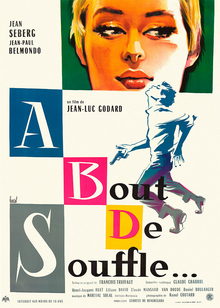
  The film breathless also knows as À bout de souffle(French), is a French New Wave crime drama film. The writer and also the director is Jean-Luc Godard. This film was produced in 1960 in France and produced by Georges De Beauregard. The running time of the film is 87 minutes and the language of this film was used French and English. This film also as the first French New Wave film. It brought attention from other countries because of its new styles of French filmmaking.

  The French New Wave was started in 1959 by Jean-Luc Godard, which is the file name Breathless. This film movement is ended in 1969 with the film named Weekend, which also directed by Jean-Luc Godard. The film in French was mainly literary adaptations, which mean that the filmmaker will find out the story from the novel and transfer it to a film. These films were usually filmed within the studio system or on big-budget spectacles and international co-productions. In the 1950s, the film movement, which is the documentary movement that happened in France. There are lots of filmmakers were making the documentary of Nazi death camps, cinema verite and sane man in the lunatic asylum. 

  The French New Wave film has used handheld shot to shot the hold movie and also used long take technique. The editing style is lots of the jump cuts that show the change of the place or also the time of the story. This film movement rejected montage aesthetics and favouring on mise-en-scene. The ideology of this selection is because they think the film should not just be intellectual or rational experiences, it might also include the emotional and also psychological experiences. The next is about personal authorship, the ideology of it is the "Policy of Authors" or the Auteur Theory. It states that the film should be an agency of personal artistic expression, bearing the filmmaker's signature, which the personality, controlling the obsession and cardinal themes. By the way, the dialogues of the character might be improvised, it can look more natural than only follow the plot. In 1969, the directors have developed their own styles and made mainstream films based on this film movement. It is also the end of the "wave".


  Michel who is the criminal, he stole a car in Marseille and shoots and kills a policeman that who follow him. When he was on the run from police, he fell in love with the American, who named Patricia, a student also an aspiring journalist who sells the New York Herald Tribune. After that, she knows that Michel is a criminal from the police. At last, she decides to betray Michel, and tell him what she was done. The police shoot Michel in the street and he died out of breath.


  In this film, there are some of the dialogues are improvised from the actor, they make the talk between each other become more natural. For example, the beginning of the scene, which is the first scene that Michel driving on the car, few of the dialogue is improvised himself. The more special things in this movie are about the camera movement, which is the handheld camera. We can notice that sometimes the camera was not stable like the first scene in the car, the camera was a bit shaking. Also when the police shoot Michel at the last scene, the camera was shaking little to show that the effect of they have running, it makes the movement become more realistic. About the sound, this film was recorded all of the sounds of the scene. For example, when Michel was talking to Patricia, we can notice that there is some sound come from the windows, like the sound caused by the car. The editing style is the jump cut, the audiences can notice that there are lots of the jump cut used in this film. For the example of Michel shoot the police, he picks out his gun, the camera focus on the gun and cut to the police get shooting with the gun shooting sound effect. It can let the audience know that the police was shot by Micheal. However, sometime the audience will get a little bit confusing when the jump cut was using in a bad way. The long shot also applied to this film, which is Michel talking with Patricia in her apartment. It takes a very long time to show them talking with each other.

  In conclusion, the French New Wave is a film movement that appears in the early 1950s until the 1960s. It uses lots of jump cuts as the editing style and the long shot. Sometimes the dialogue of the characters might be improvised, it can look more natural. Also, they were favouring on mise-en-scene. The filmmakers develop their own new style film after the 1960s. Jean-Luc Godard is the only people that continue with this film movement.


....
  

2019年3月24日星期日

Film Study-Bicycle Thieves

“Bicycle thief 1948”的图片搜索结果

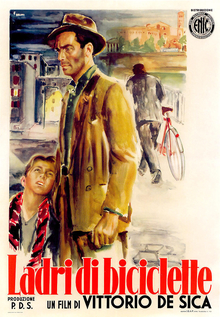
  Ladri di biciclette (Italian), also know as Bicycle Thieves is an Italian neorealism film, which directed by Vittorio De Sica in 1948. The producer of this film is Ercole Graziadei, Sergio Bernardi and Count Cicogna. This film received an Academy Honorary Award in 1950 and it also the greatest film of all time by Sight & Sound magazine's poll of filmmakers and critics. Until now, no matter it is a very old film, it also as a great film to influence the movie nowadays.

  Italian neorealism is one of the art styles that cause by World War II, which the main reason that devastated the national cinemas tremendously and it affects the stability of the cinema's economic. The Nazis destroyed the prewar European economy for setting up their own economy threshold. However, it hasn't maintained for a long time, the Nazi economy was eliminated when the end of World War II. Mashall Plan rebuilt the European national industries and allowed the production to develop and become large-scale. Another side, Italy's production facilities were intact because of early surrender when facing World War II. In 1922, Benito Mussolini takes over permission to make the Italian cinema was used as a form of propaganda, educating Italians with documentaries and newsreels. Benito Mussolini set up Cinecitta studios in Rome and he took charge of the studios and doubled Italian production within a year in 1937. Cesare Zavattini, who is the theoretical founder of neo-realism in 1942. He was suggesting the new form of Italian Cinema that abolishes contrived and planned plots, so he used the real people and location to build up the relation with contemporary social reality. Cesare Zavattini looked at the plot as a fake structure, the professionals' actors have complemented the lies. The first of the Neorealist film is Rome, Open City. It mostly shot on-location, which also in the ruins of the post-war era as the setting of the film. The grainy film stock is also has been used, it can give the newsreels look. About the sound, it was recorded and added after the shoots, it can also know as editing. The actor in this kind of film is a mixture of professional actors and non-actors. They usually used the Point of View shot to present the Socially-conscious and humanistic. It also has the element of melodramatic and also motivated to rebuilt national reputation. Neorealism was also known as a cinema of poverty and pessimism. It has been declined started from the 1950s, because of the changing of times, everything was changing for the better. It is revolutionary and happened between the time of non-revolutionary and prosperity and affluence.

  The story is set in the post-World War II Val Melaina neighbourhood of Room. Antonio Ricci receives the job of posting advertising bills. In the first day of his work, when he was posting the poster on the wall, there has a young man that snatches his bicycle. Antonio chased the thief, however, he misses the thief and failed to get back his bicycle. Antonio finds out some ways to find his bicycle back, but it failed again. After that, he encounters the thief and wanted to searches the thief's apartment. At the result, Antonio doesn't have witnesses and he failed for it. He and his child, Bruno leave in despair. After that, Antonio sees an unattended bicycle near a doorway. He decided to steal it, and he has been caught. The bicycle's owner notice s Bruno and forgive Antonio.

  In this film, the audience can notice that the stage, the scene is shot on the location. The environment of the place like the house was a bit different from other houses, it due to the building is still developing. The actor in this film is only one of the professional actor and others were the social actor. The main character in this film is the social actor, who were the people that don't have a lot of the experience on performance or acting. However, he can perform his character very well because they usually have the same kind of experience that familiar in the film. It totally applied Contemporary Social Realism in the film. Neorealism is showing the feeling of sadness, despair in this film. The main character Antonio Ricci as the desperate role in this film. He lost his bicycle when he was working, but the result is he failed to get his bicycle back. On the ways that he finds his bicycle, he started to change his mindset and want to steal others bicycle, however, he has been caught by lots of people. Antonio Ricci is feeling very unfair and also despair when his bicycle stolen by others, there don't have lots of people to help him. This is how the director applied Contemporary Social Realism in the film. It actually will always happen in our daily life.

  In conclusion, people can learn something through by Neorealism film like Contemporary Social Realism. We can notice that this concept also appears in our daily life. However, this film movement was declined in the early 1950s,


 ......


2019年3月23日星期六

FILM STUDY: The Maltese Falcon

                                                The Maltese Falcon.jpg


  The Maltese Falcon is a film noir directed by John Huston. It released in 1941 in New York. This film is a dark film noir in the early 1940s in Hollywood. This film received three nominations at the 14th Academy Awards which is the  Best Picture, Sydney Greenstreet for Best Supporting Actor and John Huston for Best Adapted Screenplay.


  Film noir is a type of American films that 'invaded' French cinemas after World War II. The term film noir is about the "dark film" also "black film", the first film that applied to Hollywood films by French critic Nino Frank in 1946. Film noir also features a world of criminals of darkness and violence with characters' central motives are usually greed, lust and ambition, drenched in fear, there don't have a perfect people in this world. In film noir, the audiences can see a lot of shadows in the film, which is caused by the dark. The lighting is usually used the high-contrast lighting, also knows ad the low key lighting, the scene usually lit for night. About the setting, the characters always appeared in the alleyways, cramped corridors and others of the specific places, and these setting in city-bound, comprising of the rain-washed road and dimly-lit interiors. The theme for this movement is cynical, pessimism and dark. It corrupted characters, fatalistic themes, hopeless tones, blurred morals and intellect. About the character, it is the hard-boiled antihero versus femme fatale film that shows the tales of criminal motives.


  About the story of this film is talking about a private detective, who named is Sam Spade, and his partner named Miles Archer. However, Sam not really like Miles. One day, a woman named Miss Wonderly appears in front of them, and everything has been change by that day. Miles has been killed. Miss Wonderly is surrounded by some dangerous men. And the story of the film starts, which shows the true side of mankind in this story.


  The Maltese Falcon was used lots of the shadow that to present the meaning of the scene to audiences. They use the high contrast lighting to shoot to the character and create the shadow to show the feeling of the character, like depressed, dangerous and others. The main character in the film is a hard-boiled antihero, the personality of the main character should be very selfish or others of the negative personality, it can have a strong contrast with others main character that from the different type of film. Also, there have two different kinds of female character in film noir, it can show the contrast between each other. The femme fatale, which is the female that take some advantages from the man to achieve the goal or something that she wants, usually these kinds of character will get the punishment in the last of the film. Other than, the pure or good female character will always help, care or support others character. However, each of these characters is not pure of good.


  In conclusion, The Maltese Falcon is a film that can have a representative about the real, which is our daily life. There are don't have the pure of a good person in this world, actually, the one who is going to help you will have some motivation, maybe he or she wants to be closer than you, or others of the reason. The only difference in motivation is good or bad.

2019年3月8日星期五

Film Study- Corpse Bride


  For the film study this week, the film I want to talk about is Corpse Bride, which is the movie that applies the concept of German Expressionism. It releases on 2005. It is an animation movie, the stop-motion animated dark comedy movie. In this kind of film, the audience can see a lot of the high contrast scene in the movie.

  German Expressionism, it is a filmic style that emerged in Germany from 1919 until 1926. It influenced by the Expressionist movement in modern art of the early 1900s. The Germany Expressionist started to fade as 1920s German film industry tries to imitate and compete with Hollywood films. The expressionism was not limited to painting only, it also manifests in the literature, theatre and architecture of Scandinavian and German-speaking countries. Most of the filmmakers whose migrated from Germany to the USA, they brought the filmmaking practice to Hollywood. It made a very big influence on horror films and film noir, the quality of these kinds of genre improve very well. The famous German Expressionist filmmakers are Fritz Lang, Robert Weine, and F.W.Murnau. The theme that inside the German Expressionism film is include revolt, self-analysis, madness and primitive, and sexual savagery. In the film Corpse Bride, there are also some of the themes were applied to it.

  The beginning of the story is talking about Victor has been arranging to marry a woman. However, Victor hadn’t met the woman before. When Victor met the girl, who named Victoria, they fall in love with each other. After several days, Victor was prepared to marry Victoria, but he forgot his wedding vows. When he passed the forest, he uncarefully places the ring on the corpse’ hands. The corpse who named Emily misunderstood Victor, and bring him to go to hell. Victor was tried back to his world and he knew about the story of Emily. When Victor knew Victoria was going to marry Mr. Barkis, he felt sad and decide to marry Emily by drink the poison. At the last, Emily stops Victor because she doesn’t want, he dead.

  There are some of the themes that the audiences can see in the movie, of example revolt. When Victoria’s parents want, she to marry Mr. Barkis, she very resists for the decision of her parents. She escapes to outside through the window, and try to request some help to save Victor because she knows that Victor is staying with a bride. The next theme is about madness. When Victor first arrived at the hell, which is the place od the dead people staying. Victor had feeling about the environment, the ghost or everything in the hell is very madness. So, he tries to escape the hell just because he feels fear of these. Thirdly, the body and the shape of the character is also a theme we could found out. We can notice that lots of the character’s body or face shape is very unnatural compared to the real human. In design, it can say that this a very stylized design of the character. For example, the mother of Victoria, the face shape of her is like a peanut. Do you imagine that can find out a peanut face in the real world? Back to the other theme is about the self-analysis. For example, in the film, Victor and Victoria don’t have any choice and must listen to the elder for the marriage. In that time, they don’t know each other, but they still follow their parent to meet and marry each other. It was not the decision of Victor and Victoria, they just follow what their parents want. Lastly but not least, the lighting also as the theme in this film. The lighting is related to another art movement, which is the surrealism content. The different of the light can show the different feeling for the audience, no matter a character or a place, it can be used to affect the feeling of the audience. It is a very important theme for the Germen Expression, because it can make the shadow to influence the feeling of the audience. For example, when Victor passes to the forest, there is a lot of the shadow caused by the trees. It makes the environment become very sombre and scary. Other than, some of the scene using the blue, red and green colour to make an effect of the contrast value, like the colour of living have lots of the shadow, lack of colour, using cool colour to show the town. It feels very boring and also lifeless compared to the hell, which is the place that put lots of the colour. By the ways, the ghost in the hell is more active than the living people.


  In conclusion, this movie was made by the German Expressionism and used some of the themes to attract the attention of the audiences. The director of this movie shows that It shows how well the theme can use like, especially the lighting, which is the high contrast also know as low-key lighting to create dramatic shadows.

2019年3月1日星期五

Film Study: In the Mood for Love

                                                      In the Mood for Love movie.jpg

  In the Mood for Love is a 2000 Hong Kong romantic drama film. Wong Kar-wai as the writer, producer and also the director of this film. This film release at the 2000 Cannes Film Festival on 20 May. It is frequently listed as one of the greatest films of all time and in 2016 was voted the second best film of the 21st century. The story is about Mr Chow (played by Tony Leung) and a Mrs Chan (Maggie Cheung) slowly have a feeling for each other. 

  In the story, the concept of French Expressionist Cinema was applied. What is French Expressionist Cinema? It will allow the audiences to feel the emotion of the character without the narration between the characters. It can show the emotion of the character by using some of the techniques like camera angles, editing and others. 


                                   Faa yeung nin wa (2000)

  The French Impressionism film actually focuses on the psychological of the characters, which is the feeling, emotion, mood or others. In the story, it doesn't give the message to the audiences directly, it tries to present the message through by some indirect ways. The audiences will start to guess the story and understand the feeling or thinking of the character.  For example, the scene that after Mr. Chow smoking in his office, and the smoke is clouded and very gloomy, it can suggest that the emotion of Mr. Chow is very confused, unclear and the thinking is stuck. The props like the wall, door, windows and others also can create the effect of the feeling between the characters. For example, we can notice that there has a bookshelf between the place of  Mr. Chow stand and Mrs. Chow working place. It shows that there have something between them, which is they have the gap between each other, they don't have more closely with each other anymore. The other of the example is showing the facial expression of the characters through by the mirror, it is the mirror narrative. This technique is using for showing the emotion of the character, make the space of the stage become bigger, and also show the reality of the character which is the personality or the emotion in the different perspective. One of the scenes in the movie is the mirror reflects nearby Mr Chow show the Mrs Chan facial expression is very shy and sit on the bed. Actually, it shows the true emotion of the character. The other way to show the emotion or behaviour of the character is the acting of the character. There has one scene in the movie which is Mr. Chow was sick and Mrs. Chan feels hesitant to visit him or not. She goes up the stair and goes down, and the action repeat many times. It shows the feeling of hesitating of Mrs. Chan.

  The lighting also the technique that can affect the emotion of the character. There have many of the contrast colour that we can found out in this movie, for example, when Mr Chow is smoking alone in the office, the value of the background very low and there has the light on Mr Chow, it shows the contrast of the colour between Mr Chow and the background. It suggests the feeling of sadness or depression. 

    The story is started in an exiled Shanghainese community in Hong Kong in 1962. Mr Chow and Mrs. Chan move to the same apartment on the same day. They become the next-door neighbours and their spouse always busy at work and leaves them alone. Mr Chow and Mrs Chan notice that others are always staying alone in their own room. Due to them have them have similar to the situation, they slowly close up with each other. They nurse suspicions about their partner fidelity. The conclusion is their spouses have been seeing each other, Mr Chow and Mrs Chan start to think about the situation that should happen of their spouses. Mr Chow invites Mr Chan to help him write a martial arts serial for the papers. Their neighbour notice that Mr Chow and Mrs Chan always together, the friendships between men and woman bear scrutiny on that day(1960s). As time goes by, they notice that they are fall in love with each other. However, their love doesn't have a good result at the end of the story.

  In conclusion, this film has presented the emotion or feeling of the character through by French Expressionist Cinema that without any of the dialogue. This kind of movie is my first time to watch, I feel very interesting that the ways of present the emotion of the character especially the ending of the movie, I think there would have some interaction in the ending, however, it just show Mr. Chow rely on the wall and doesn't show the facial expression.